Unified Systems Intelligence Introduces AI Assistant Modules for Smarter Form Workflows
March 17, 2026
The Form Isn’t the Problem. The Structure Is.
Over the last year, a pattern has repeated across construction firms, safety teams, and operational departments. Everyone wants better reporting. Everyone wants clean safety records. Everyone wants documentation that holds up during audits. Yet the environments where this information originates remain largely unstructured. Job sites generate photos, note, conversations, emails, PDFs, and quick uploads from mobile devices. That is the natural rhythm of construction work.
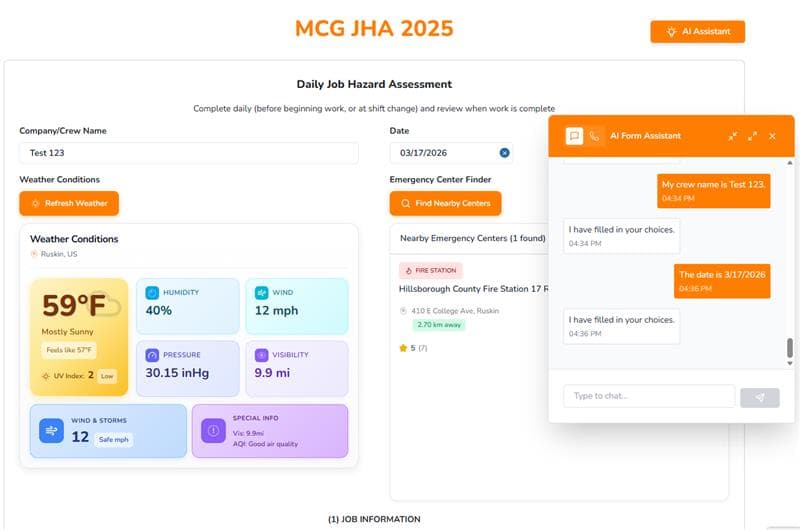
Crews move quickly, supervisors document hazards on the fly, and information travels through whatever channel happens to be available at the moment. The problem is not that the information exists. The problem is that compliance systems do not operate on unstructured information.
Regulators, insurers, and prime contractors do not accept loose narratives as proof of compliance. They require structured records. A Job Hazard Analysis cannot live as a paragraph inside an email thread. A safety incident cannot exist only in a text message between supervisors. Workforce credentials cannot remain buried inside a folder of scanned documents.
Compliance requires structured data that can be categorized, verified, and reported consistently. When that structure does not exist at the point where information enters the organization, companies spend enormous amounts of time attempting to rebuild it later. That is not a workforce problem or a discipline problem. It is an intake architecture problem.
Many construction companies believe they have documentation simply because information exists somewhere in their systems. A supervisor wrote notes. A foreman uploaded a PDF. Workers shared photos from the job site.
On the surface, it feels like documentation exists and the requirement has been satisfied. But when safety audits occur or when a contractor must produce records for a general contractor, insurance carrier, or regulator, the illusion begins to collapse.
The Job Hazard Analysis cannot be queried across projects. The hazard classifications cannot be aggregated for reporting. Training records cannot easily link to individual workers. Incident documentation cannot be analyzed across multiple crews. Information that looked useful in isolation fails to function when it must support structured reporting.
At that point, operational teams begin the same reconstruction process every time. Someone reads through submissions manually and tries to interpret what the worker meant. Someone else classifies hazards after the fact.
Documents are renamed, categorized, and entered into spreadsheets or secondary systems. Information is copied into another tool so it can finally resemble a reportable record. What initially appeared to be documentation turns into a labor-intensive data cleanup effort. The organization spends more time repairing data than learning from it.
The construction industry has historically resisted heavily structured software environments, especially SaaS platforms. The instinct comes from real operational experience. Construction sites are dynamic, and crews cannot spend their day navigating rigid systems while work continues around them.
Flexibility matters in the field. However, compliance requirements do not share that flexibility. Safety reporting, OSHA documentation, workforce validation, and Job Hazard Analyses all rely on standardized data structures. Without structured inputs, companies cannot reliably produce structured outputs. The tension between unstructured field activity and structured compliance requirements eventually becomes unavoidable.
When organizations attempt to operate entirely in unstructured environments, they eventually reach a point where reporting becomes fragile. Safety records vary from project to project. Audit preparation requires weeks of document collection. Insurance reporting becomes difficult to verify.
General contractors begin questioning documentation reliability. Compliance teams find themselves spending more time organizing information than improving safety outcomes. None of these issues stem from bad intentions or poor execution in the field. They emerge because the systems capturing the information never required structure when the data first entered the organization.
The real solution does not begin with reporting systems. It begins at intake. If the intake process allows vague responses, the data will remain vague. If hazard classifications are optional, they will frequently be skipped. If documentation expectations remain unclear, workers will upload whatever seems close enough to satisfy the requirement.
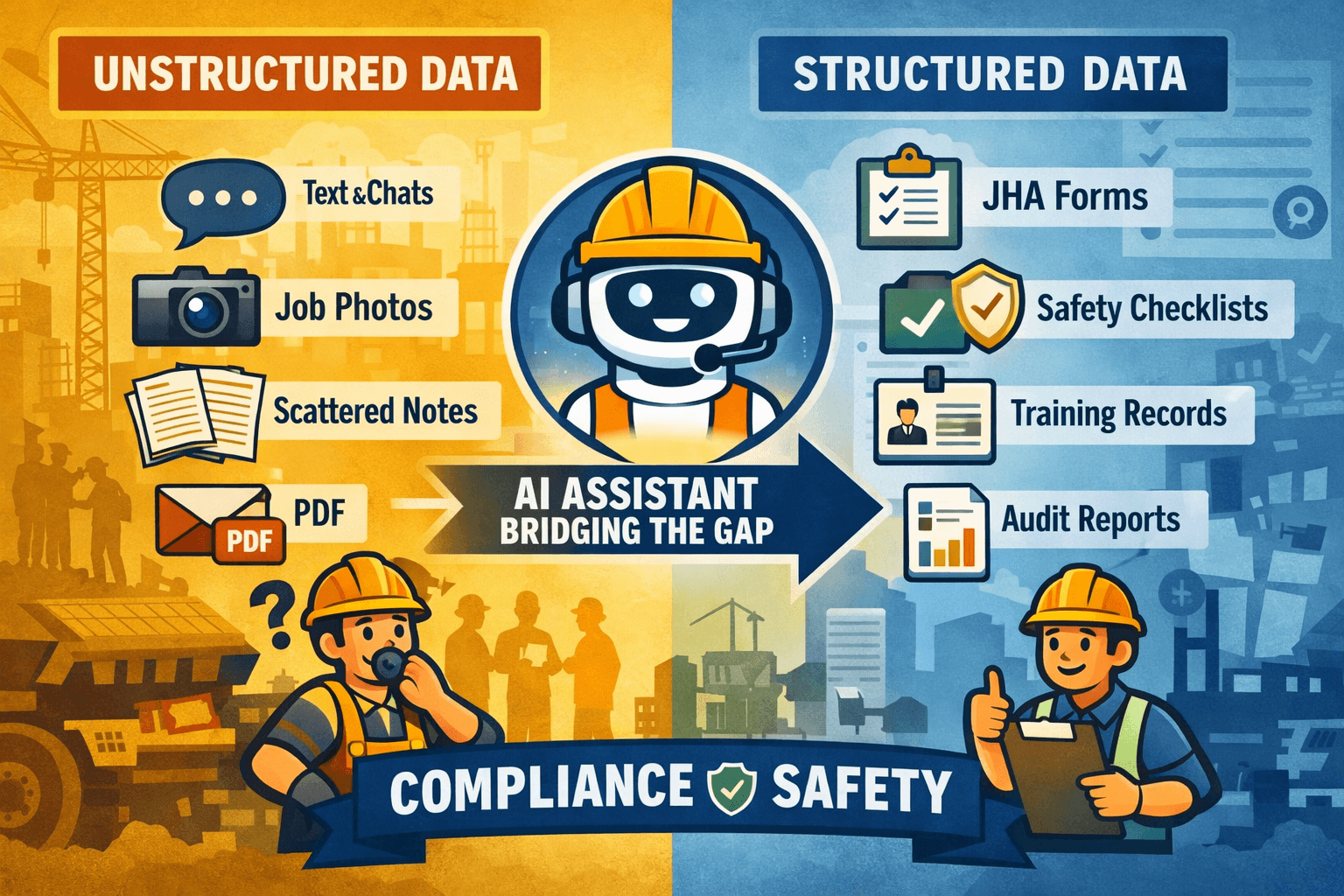
By the time the information reaches a compliance report, the opportunity to capture it properly has already passed. Reporting tools cannot repair weak intake. They can only summarize what was captured.
When organizations introduce structure at the intake layer, the situation changes dramatically. Job Hazard Analyses begin arriving categorized and searchable. Safety hazards align with predefined risk classifications. Workforce credentials link directly to workers, roles, and projects.
Incident reports begin generating usable safety analytics rather than isolated narratives. Compliance reports become easier to generate because the system captured the data in a usable format from the beginning. The field environment remains dynamic, but the information entering the system becomes structured enough to support the compliance requirements that follow.
Construction will always produce unstructured information at the job site. That reality will never change. Crews will continue to communicate through conversations, photos, and quick documentation captured during the workday. However, compliance systems cannot operate on unstructured inputs alone. Somewhere between the job site and the final safety report, that information must become structured.
Organizations that recognize intake as an architectural layer address this challenge early. Those that do not end up rebuilding structure manually each time a safety review, audit, or regulatory report demands it. By the time that moment arrives, the cost has already been paid in time, labor, and operational risk.
The form itself is rarely the problem. The real issue lies in whether the system behind the form captures information in a way that supports the structured requirements of compliance. When intake treats structure as optional, reporting becomes painful. When intake enforces structure intelligently, compliance becomes a natural byproduct of daily operations rather than a separate administrative burden.