Best AI Agents for Software Development: Benchmarking the Landscape
May 21, 2026
Why benchmarks matter—and why structure matters more
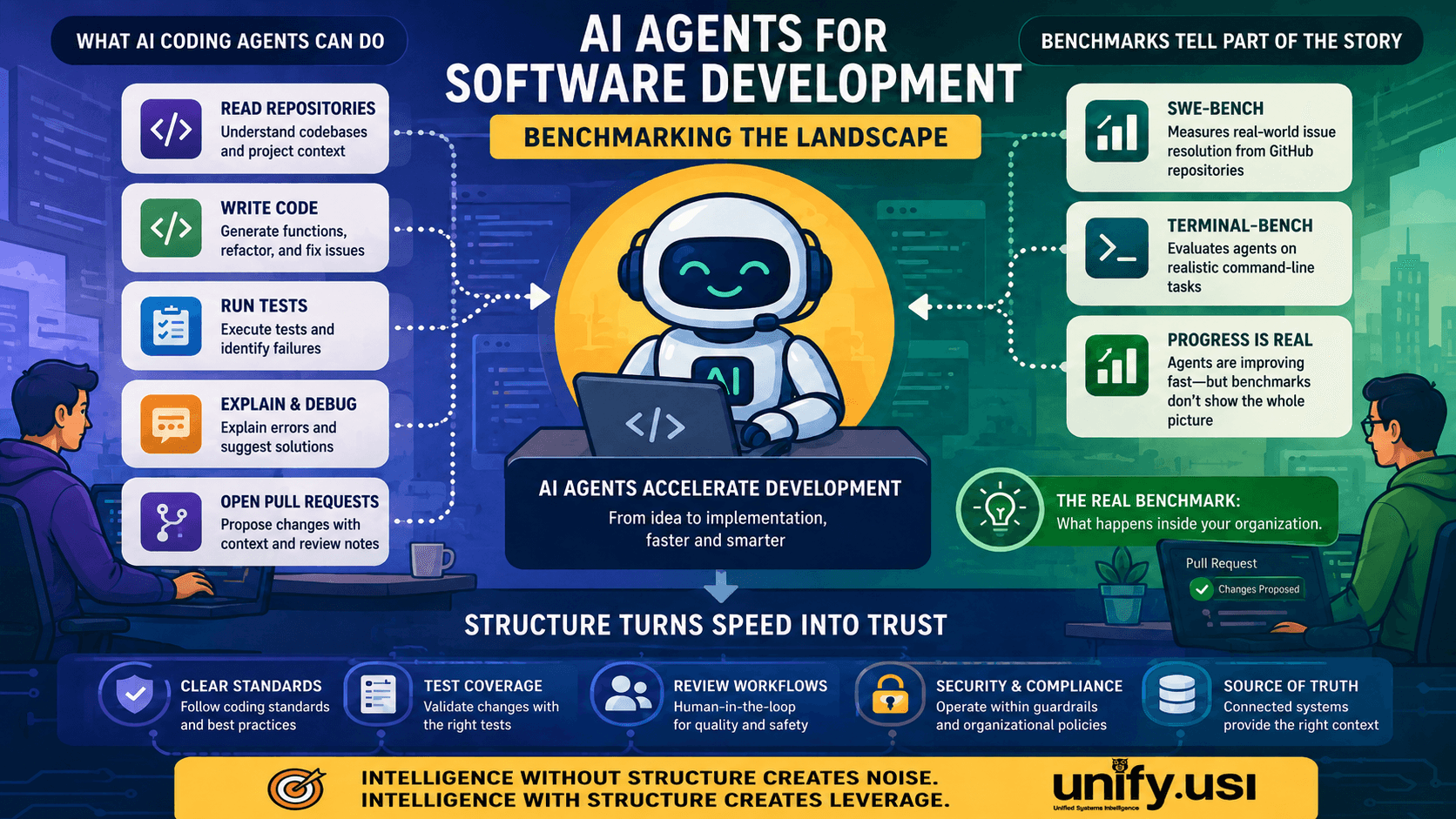
AI coding agents are no longer just autocomplete tools. They can read repositories, write code, run tests, explain errors, open pull requests, and work through multi-step development tasks with increasing autonomy.
That progress matters. Software development is entering a new phase where the question is not whether AI can generate code. The question is whether AI can participate in the development process in a way that is structured, reliable, and reviewable.
That distinction is important.
A fast AI agent can still create slow problems if its output is difficult to validate, poorly documented, or disconnected from the way a team actually builds software. In development, speed only creates value when it moves through the right system.
Benchmarks Are Helpful, But They Are Not the Whole Story
Benchmarks like SWE-bench, Terminal-Bench, and other coding evaluations give the industry a useful way to compare progress. SWE-bench evaluates how well models and agents resolve real software issues from GitHub repositories, while Terminal-Bench evaluates agents on terminal-based tasks across areas like software engineering, security, data science, and system administration.
These benchmarks are valuable because they show how quickly AI agents are improving. They also show something equally important: software development is not one task.
Fixing a contained bug is different from building a full feature. Writing a test is different from understanding a business rule. Opening a pull request is different from knowing whether that pull request fits the architecture, security model, and long-term direction of the product.
That is where many teams misunderstand AI coding performance. A high benchmark score does not automatically mean an agent is ready for production ownership. It means the agent performed well under a specific test environment.
The real benchmark is what happens inside the organization.
The Agent Landscape Is Splitting Into Categories
Today's software development agents generally fall into a few groups.
Some agents live close to the developer, inside the IDE or terminal. These are useful for pair-programming style work: editing files, explaining code, generating tests, and helping engineers move faster without leaving their workflow.
Other agents work more asynchronously. GitHub's Copilot cloud agent, for example, can research a repository, create a plan, make code changes on a branch, and optionally open a pull request.
Then there are broader AI-native development environments that combine code editing, repository awareness, chat, command execution, and task delegation into one workspace.
Each category has value. But none of them removes the need for structure.
In fact, the more capable agents become, the more structure matters.
The Problem Is Not Code Generation. The Problem Is Control.
AI agents can produce code quickly. That is no longer the hard part.
The harder question is whether the work can be trusted.
Did the agent understand the repository?
Did it follow the right standards?
Did it run the correct tests?
Did it explain the change clearly?
Did it create new technical debt?
Did it solve the actual problem, or just the visible symptom?
This is where software teams need to think beyond tools and start thinking about operating models.
An AI coding agent without structure can create activity without accountability. It can generate changes, but those changes still need context, validation, review, documentation, and governance.
That is the same pattern appearing across every serious AI use case. AI works best when it operates inside a system that defines what good output looks like.
Why Structure Becomes the Advantage
The best development teams will not simply choose the "best" AI agent. They will build the best environment for agents to work inside.
That means clear repositories, clean requirements, documented standards, test coverage, review workflows, and connected systems that give AI the context it needs. Without those foundations, even a powerful agent is guessing through fragments.
This is where the conversation moves closer to USI's larger view of AI.
Unify is built around the belief that AI becomes more valuable when it is connected to structured workflows, verified data, and operational context. Whether the workflow involves workforce compliance, training records, credential management, document automation, or software development, the pattern remains the same: intelligence needs structure before it can create reliable action.
AI agents do not replace the need for systems. They expose the quality of the systems already in place.
The Future Is Human Direction Plus Agent Execution
The future of software development is not agent versus engineer. It is human direction plus agent execution.
Engineers will continue to own architecture, judgment, security, product logic, and final review. Agents will increasingly handle repetitive work, draft implementation paths, generate tests, summarize changes, and support faster iteration.
The winning teams will be the ones that know how to assign work to agents, evaluate the output, and keep every action connected to a clear source of truth.
That is the real benchmark.
Not just whether an AI agent can write code.
Whether the organization can turn that code into trusted progress.
Takeaway
The best AI agents for software development are not defined by one leaderboard. They are defined by fit, structure, and accountability.
Benchmarks show that AI coding agents are getting stronger. Real-world adoption will show which organizations are ready to use them well.
Because in software development, as in operations, intelligence without structure creates noise.
Intelligence with structure creates leverage.