Creating an Automated Hiring Pipeline with Unify.ATS, Unify.HRM, and Unify.CMS
July 8, 2026
Connecting applicant tracking, HR readiness, and compliance in one workflow
Hiring does not fail because organizations lack candidates.
Hiring fails when the process loses structure.
A candidate applies. A recruiter reviews the profile. A hiring manager needs feedback. Interviews need to be scheduled. Compliance steps need to be completed. Background checks, I9 requirements, E-Verify, motor vehicle record checks, drug testing, onboarding tasks, and workforce records all must move at the right time.
Each step matters.
But when those steps live in disconnected systems, hiring slows down. Applications sit on one platform. Candidate evaluations move through email. HR requirements are tracked separately. Compliance documents are stored in folders. Onboarding begins before every record is ready.
That is the hiring gap.
The problem is not only recruitment.
It is the workflow behind recruiting.
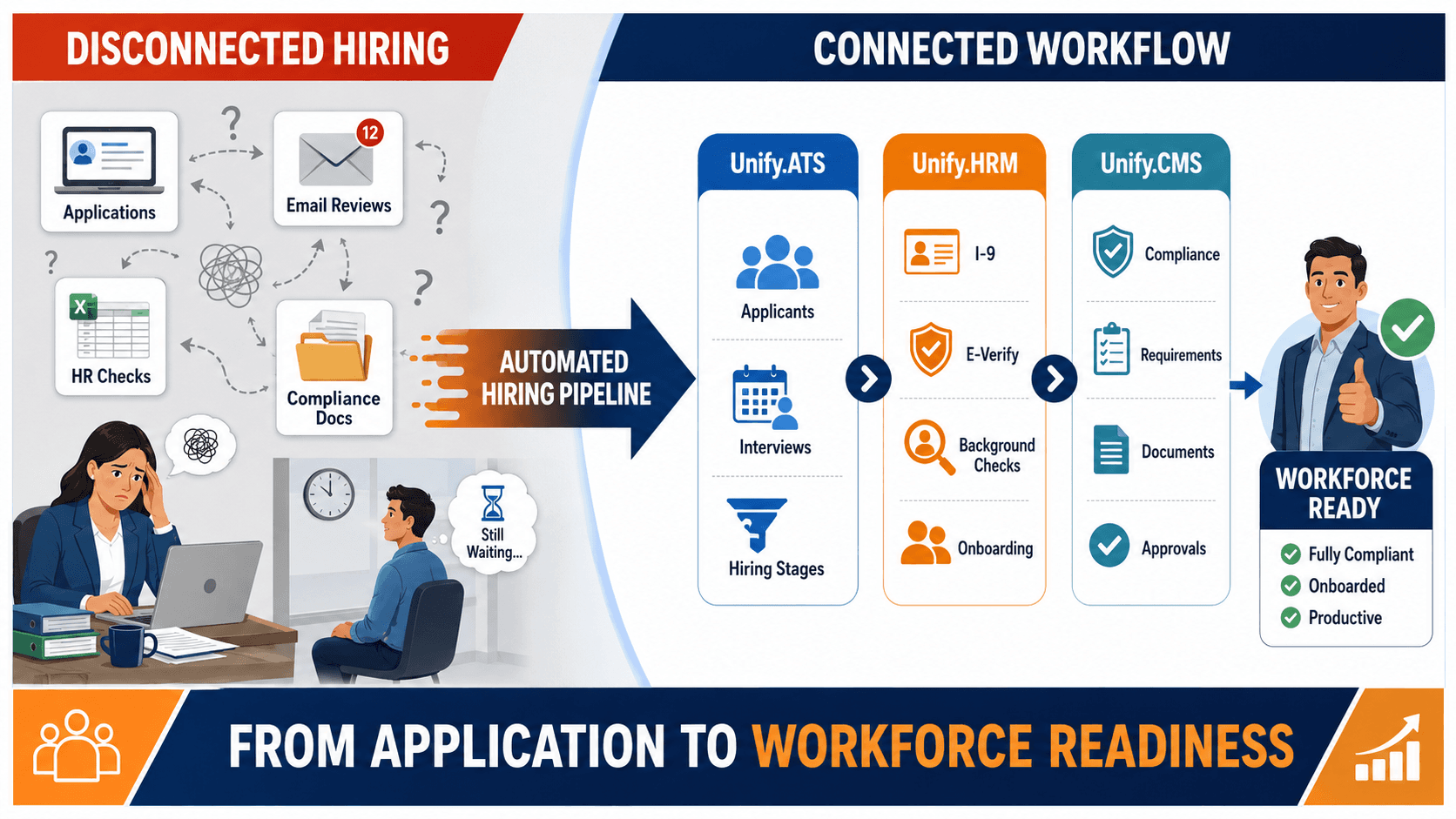
The Cost of a Disconnected Hiring Process
Hiring teams are often judged by speed, but speed becomes difficult when information is scattered.
Recruiters spend time chasing updates instead of evaluating talent. Hiring managers lose visibility into candidate status. Candidates wait longer for communication. HR teams receive incomplete records. Compliance checks happen too late. Onboarding starts with missing documents, unclear ownership, or duplicate data entry.
Every handoff creates an opportunity for delay.
A candidate may look ready to move forward, but a required document is missing. A manager may assume someone else sent the follow-up. HR may not have the information needed to begin onboarding. A compliance requirement may surface after the offer, creating avoidable friction.
These delays do not always come from poor effort.
They often come from disconnected systems that were never built to work together.
Start With Unify.ATS
Unify.ATS supports the first part of the hiring journey: finding, reviewing, and moving candidates through the recruitment process.
It gives hiring teams tools for job posting, applicant management, candidate profiles, job pipelines, saved candidates, grading, notation, interview scheduling, company calendars, resume uploading, reporting, and recruitment integrations.
That matters because a hiring pipeline needs more than a place to store applications.
It needs structure.
Recruiters need to know which candidates are new, which candidates need review, which candidates are moving forward, and which candidates require action. Hiring managers need an organized way to review information, provide feedback, and stay aligned with the recruiting team.
Unify.ATS helps create that foundation.
It turns candidate activity into a visible process that teams can manage.
Connect Hiring Decisions to HR Readiness
Hiring does not end when a candidate is selected.
That is where HR readiness begins.
Unify.HRM supports the next part of the process by helping organizations manage essential HR requirements, including I9 compliance, E-Verify sync, background checks, motor vehicle record checks, drug test scheduling, employee onboarding, and time tracking.
For telecommunications contractors and field-based organizations, this connection is critical. A candidate may be qualified on paper, but they still need the right HR steps completed before they can move into the workforce.
When applicant tracking and HR management are disconnected, teams can lose momentum after a hiring decision. The candidate may be ready, but the process is not.
Unify.HRM helps close that gap.
It gives teams a more organized way to move from candidate selection to onboarding readiness without relying on scattered emails, manual reminders, or duplicate records.
Use Unify.CMS to Strengthen Compliance
Compliance cannot be treated as a side task.
It is part of the hiring and workforce readiness process.
Unify.CMS, the Unify Compliance Management System, helps organizations manage requirements, vendor document onboarding, compliance tracking, certificate of insurance tracking, workflows, reporting, custom forms, API access, and webhooks.
That becomes especially important when hiring connects to contractors, subcontractors, vendors, project requirements, or customer-specific compliance standards.
A worker may need documentation before being assigned to a job. A vendor may need records reviewed before work begins. A project may require proof that specific requirements have been met. A compliance team may need visibility into what is complete, what is pending, and what needs review.
Unify.CMS helps bring those requirements into a more structured process.
Instead of treating compliance as a final checkpoint, teams can connect it earlier to the hiring and onboarding workflow.
That creates fewer surprises.
Automation Reduces Administrative Friction
Automation does not replace hiring judgment.
It removes unnecessary administrative work so teams can focus on better decisions.
In an automated hiring pipeline, tasks can be assigned when a candidate reaches a new stage. Interviews can be scheduled with clearer visibility. Candidate notes and grades can stay connected to the applicant profile. HR checks can be triggered earlier. Compliance documents can be requested and tracked. Reports can give teams a clearer view of hiring activity and process status.
That kind of visibility changes how hiring teams operate.
Instead of asking where a candidate stands, teams can see the status.
Instead of waiting for someone to remember the next step, workflows can help move the process forward.
Instead of discovering missing documents after a hiring decision, teams can identify requirements earlier.
The result is not just a faster pipeline.
It is a more controlled pipeline.
Better Hiring Requires Better Handoffs
The most important part of hiring is not always the application.
It is the handoff.
Recruiting hands off to hiring managers. Hiring managers hand off to HR. HR connects to onboarding. Compliance requirements may need review before a worker is cleared for the next step.
When those handoffs are manual, teams rely on memory, email threads, spreadsheets, and follow-up messages. That creates risk.
A connected hiring workflow gives every team a clearer view of its role in the process. Recruiters know what has been reviewed. Managers know when feedback is needed. HR knows what records are ready. Compliance teams can see which requirements need attention. Operations leaders can better understand when a candidate is moving toward workforce readiness.
This is where Unify.ATS, Unify.HRM, and Unify.CMS create value together.
The candidate does not move through disconnected departments.
The candidate moves through a connected process.
From Applicant Tracking to Workforce Readiness
A strong hiring pipeline should not stop at the offer.
For many organizations, the real goal is not simply to hire a person. The goal is to prepare that person for the work they are expected to perform.
That means the hiring process needs to connect applicant tracking, HR requirements, and compliance management.
- Are the right candidate records complete?
- Has the interview process been documented?
- Are I9 and E-Verify requirements moving forward?
- Are background checks, MVR checks, or drug testing scheduled?
- Are onboarding tasks visible?
- Are compliance requirements connected to the next step?
When Unify.ATS, Unify.HRM, and Unify.CMS work together, those questions become easier to answer.
Hiring becomes less reactive.
Teams can move from application review to onboarding readiness with fewer gaps, fewer delays, and less manual coordination.
The Unify Approach
Unify is built around a simple idea: work moves better when information stays connected.
In hiring, that means candidate data should not disappear between systems. HR requirements should not start from scratch after a hiring decision. Compliance steps should not wait until the end of the process. Documents, tasks, records, and approvals should support one connected workflow.
Unify.ATS, Unify.HRM, and Unify.CMS help organizations create a more structured hiring environment where recruiting activity, HR readiness, and compliance management can work together.
That structure matters because hiring is not one action.
It is a sequence of decisions, reviews, records, checks, approvals, and handoffs.
When those steps are connected, teams gain speed without losing control.
Takeaway
Hiring pipelines do not improve simply because organizations receive more applications.
They improve when the process becomes easier to see, manage, and trust.
Unify.ATS, Unify.HRM, and Unify.CMS help organizations connect the hiring journey from candidate application to workforce readiness. By bringing applicant tracking, HR management, and compliance management into a more automated workflow, Unify helps reduce administrative friction, improve visibility, and create a better experience for recruiters, managers, HR teams, compliance teams, and candidates.
The result is not just faster hiring.
It is smarter hiring.
Because when every step is connected, every decision has more context.